

Scotland’s Most Romantically Ruined Castle
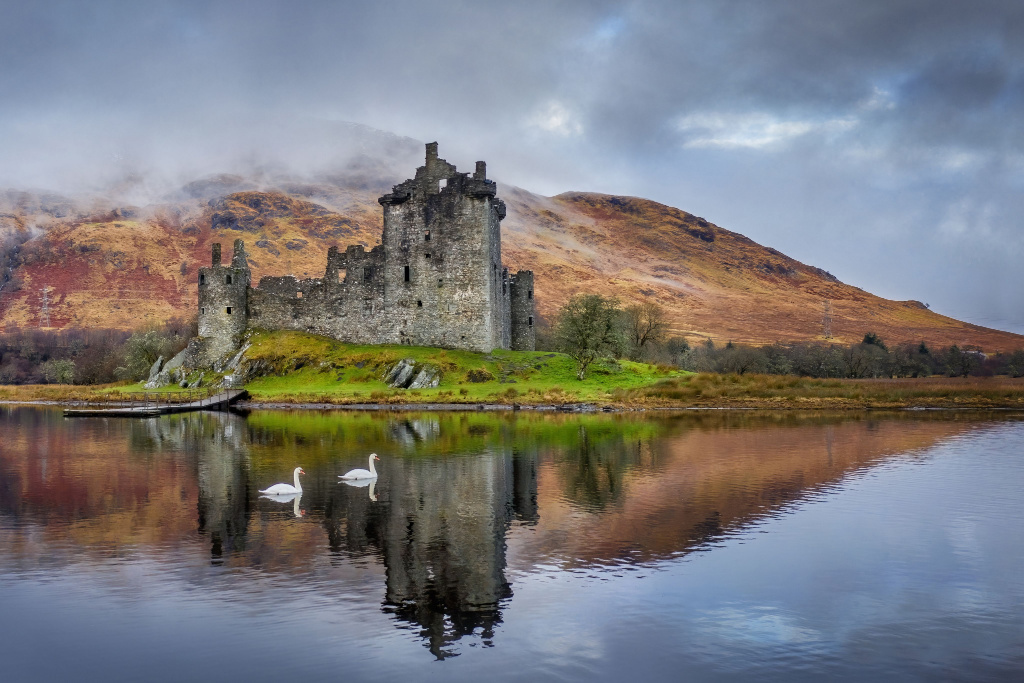
Not every castle needs to be intact to be magnificent. Kilchurn Castle, rising from a rocky peninsula at the eastern end of Loch Awe in Argyll and Bute, is a ruin — and one of the most hauntingly beautiful ruins in all of Scotland. Its roofless towers and crumbling walls have a quality of melancholy grandeur that no amount of careful restoration could replicate. When morning mist drifts across the surface of the loch and softens the outline of the castle’s skeletal towers, the scene is of an almost surreal picturesque beauty that has drawn painters, poets, and photographers for centuries. Kilchurn was one of William Wordsworth’s favourite subjects, and Turner painted it repeatedly. Standing before it today, it’s easy to understand why. This is a place where landscape and ruin combine to create something genuinely transcendent.
The History of Kilchurn
Kilchurn was built in the mid-15th century by Sir Colin Campbell of Glenorchy, the founder of a branch of the powerful Campbell family that would go on to dominate much of the Scottish Highlands for the next two centuries. The original structure was a rectangular tower house, but the castle was significantly expanded over the following 200 years as the Campbells’ wealth and power grew. The most significant addition was made in the 1690s by the first Earl of Breadalbane, who converted part of the castle into a barracks for around 200 soldiers — one of the earliest purpose-built military barracks in Scotland. The castle’s military career was relatively brief: it was occupied by Hanoverian troops during the Jacobite rising of 1745 and thereafter gradually fell into disuse. By the late 18th century, a dramatic storm had brought down two of the towers, and the castle has been a ruin ever since.
The Setting
It is impossible to overstate the magnificence of Kilchurn’s natural setting. Loch Awe is the longest fresh-water loch in Scotland, stretching for over 40 kilometres through the heart of Argyll, and the eastern end of the loch, where Kilchurn sits, is particularly dramatic. The castle’s peninsula — sometimes partially submerged to form a small island when water levels are high — projects into the loch with the castle’s towers reflected in the still water below. Ben Cruachan, one of Scotland’s most impressive mountains, rises steeply to the north, providing a backdrop of rugged grandeur that perfectly complements the castle’s romantic decay. The surrounding area of Glen Orchy and the Pass of Brander has its own rich history, and the combination of landscape, history, and natural beauty makes this one of the most rewarding areas of Scotland to explore.
The Architecture of the Ruin
Despite its ruinous state, enough of Kilchurn survives to give a clear impression of what a substantial and significant stronghold it once was. The original 15th-century tower house forms the core of the complex, its walls still standing to near full height in places. Around it, the later additions — a great hall range, ancillary buildings, and the early barracks — can be traced in the surviving walls and foundations. The main tower’s staircase can still be ascended in part, and from the upper levels, the views across Loch Awe to Ben Cruachan and the surrounding hills are extraordinary. Historic Environment Scotland has carried out careful conservation work to stabilise the ruins and improve visitor access without detracting from the atmospheric qualities that make Kilchurn so compelling.
Visiting Kilchurn
Access to Kilchurn Castle requires a short walk from the A85 road, adding to the sense of arriving at a place slightly removed from the modern world. The castle is a free Historic Environment Scotland property, open to visitors year-round during daylight hours. The walk from the car park takes around 15 minutes along a well-maintained path, and the approach gradually reveals the castle from different angles, building anticipation magnificently. Be aware that the ground around the castle can be wet and boggy in wet weather, so waterproof footwear is strongly recommended. The castle is also accessible by boat from Lochawe village, and a seasonal passenger ferry operates when conditions permit — this is a particularly atmospheric way to approach the ruin.
Photography and the Famous Reflections
Kilchurn Castle is, without doubt, one of the most photographed locations in Scotland, and with very good reason. The combination of the ruined towers, the loch, and the mountain backdrop provides photographers with an endlessly variable composition that changes dramatically with the light and weather conditions. Early morning, when mist often lies on the surface of the loch and the light is soft and directional, is widely regarded as the best time for photography. Autumn brings spectacular colour to the surrounding hills, while winter can transform the scene with snow and ice. Sunset on a clear evening, when the castle is silhouetted against a sky of orange and gold reflected in the still loch, is an experience of extraordinary visual power.
The Wider Loch Awe Area
Kilchurn makes an ideal base for exploring the wider Loch Awe area, which is rich in both natural beauty and historical interest. The loch itself supports excellent fishing, particularly for brown trout and pike. The nearby Cruachan Power Station, built inside the mountain of Ben Cruachan, offers one of the most extraordinary visitor experiences in Scotland — a tour deep into the hollow mountain to see the underground hydro-electric facility in operation. The ruins of Inishail Priory on an island in the loch, the 12th-century Fraoch Eilean castle, and the charming village of Loch Awe with its picturesque church and pier all add further dimensions to a visit to this wonderfully rewarding corner of Argyll.