
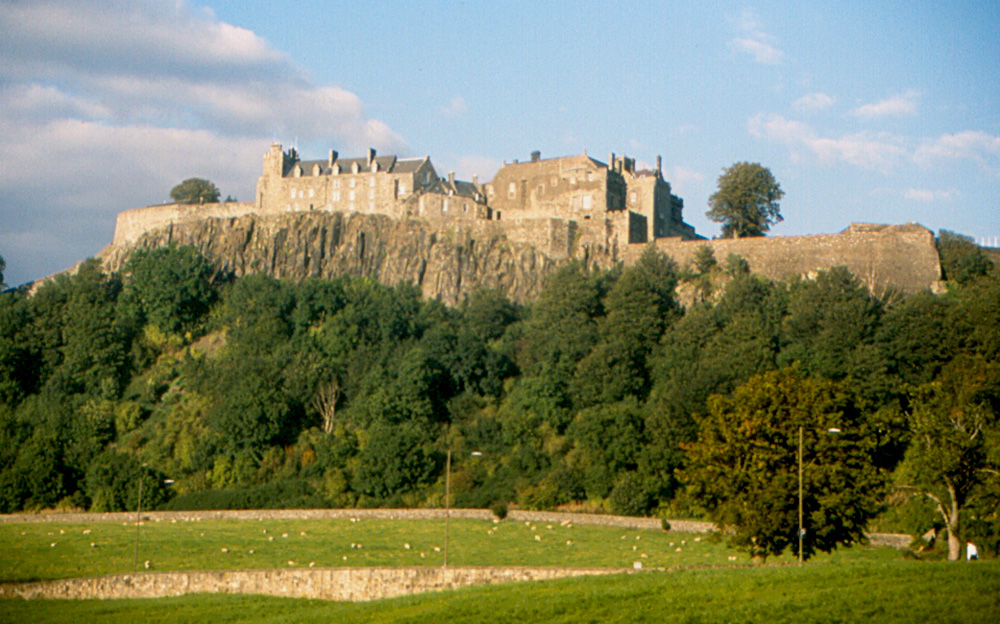
The Mightiest Castle in Scotland
If Edinburgh Castle is Scotland’s most famous fortress, Stirling Castle runs it very close for sheer historical significance. Perched on a volcanic crag above the town of Stirling at the very heart of Scotland’s central belt, this massive fortification controlled the lowest crossing point of the River Forth and therefore, for centuries, controlled access between the Highlands and the Lowlands of Scotland. Whoever held Stirling held Scotland — a fact that made it the prize in some of the most dramatic and consequential battles in Scottish history. Today, thoroughly restored and interpreted with genuine skill, Stirling Castle offers one of the richest and most rewarding castle experiences anywhere in Britain. From the magnificent Renaissance interiors of the Royal Palace to the extraordinary Stirling Heads Gallery, Stirling has something to astonish at every turn.
The Strategic Importance of Stirling
The significance of Stirling Castle in Scottish history cannot be overstated. Its position on a high volcanic rock — with the River Forth creating a natural moat on three sides and the town clustered below — made it arguably the most strategically important fortification in Scotland. The castle changed hands no fewer than eight times during the Wars of Scottish Independence, and two of the most famous battles in Scottish history were fought within sight of its walls. The Battle of Stirling Bridge in 1297, at which William Wallace decisively defeated an English army, and the Battle of Bannockburn in 1314, at which Robert the Bruce secured Scottish independence, both took place in the immediate vicinity.
The Royal Palace
The undisputed centrepiece of a visit to Stirling Castle is the Royal Palace, built between approximately 1538 and 1542 for King James V as a statement of Renaissance splendour designed to rival the finest royal residences in Europe. The palace’s exterior is adorned with a remarkable series of carved stone figures and decorated window surrounds that represent Scotland’s most ambitious piece of Renaissance architecture. The interiors have been magnificently restored in recent years by Historic Environment Scotland, with each room recreated in its original 16th-century splendour. Rich tapestries woven to the original designs, furniture based on period inventories, and painted decoration reproduced using historical techniques create an extraordinarily vivid picture of life at the Stuart court.
The Stirling Heads
Among Stirling Castle’s most extraordinary treasures are the Stirling Heads — a series of large carved oak medallions that originally decorated the ceiling of the King’s Inner Hall in the Royal Palace. Carved in the 1540s, the surviving heads depict a remarkable cast of characters: kings and queens, classical heroes, biblical figures, and unidentified faces of great individual character and presence. They represent the finest example of Renaissance woodcarving in Scotland and one of the most significant pieces of Renaissance art anywhere in Britain. The original heads are displayed in the Stirling Heads Gallery, where visitors can examine them in extraordinary detail, while reproduction heads installed in the restored ceiling allow visitors to appreciate their original context.
The Great Hall and Chapel Royal
The Great Hall of Stirling Castle, built around 1503 for King James IV and recently restored with a gleaming white lime-harled exterior, is the largest medieval secular building in Scotland. It served as the principal ceremonial space of the Scottish court and the venue for royal banquets, parliamentary sessions, and diplomatic entertainments. Its hammerbeam roof soars above an immense open space that still conveys something of the power and ambition of the Stuart monarchy at its height. The adjacent Chapel Royal, rebuilt in 1594 for the baptism of James VI’s son Prince Henry, is another remarkable space, decorated with a sequence of painted decorative schemes among the finest of their period in Scotland.
Battlefields and Views
One of the great pleasures of Stirling Castle is the quality of the views it commands over the surrounding landscape. From the castle walls, on a clear day, you can see for extraordinary distances in every direction — south to the Ochil Hills, north to the Highlands, east to the Forth estuary and the Bass Rock, west to Ben Lomond and the first peaks of the Trossachs. Perhaps most historically resonant of all, the sites of the battles of Stirling Bridge and Bannockburn are both visible from the castle ramparts, and the National Trust for Scotland’s excellent Bannockburn Heritage Centre is just a short drive away and makes an excellent complement to a castle visit.
Planning Your Visit
Stirling Castle is managed by Historic Environment Scotland and is open year-round. The castle is located in the old town of Stirling, easily accessible by car from the M9 motorway (Junction 10) or by train to Stirling station, from which a short walk or taxi ride brings you to the castle gate. Allow at least three to four hours for a comprehensive visit. The on-site facilities include an excellent café, gift shop, and audio guide service. Special events including re-enactments, family activities, and evening tours are staged throughout the year and are worth checking when planning a visit. The combination of its magnificent architecture, extraordinary collections, unparalleled historical significance, and spectacular setting makes Stirling Castle an experience that stands comparison with any heritage site in Britain.